How Input Lag Compensation Reshapes Victory Conditions in Fast-Paced Web Racing Events
Written by Sam Washington · Aug 21, 2026
How Input Lag Compensation Reshapes Victory Conditions in Fast-Paced Web Racing Events
Input lag compensation techniques have become central to browser-based racing platforms where network conditions vary widely among participants, and these methods directly alter which players cross finish lines first in competitive events. Developers implement client-side prediction alongside server reconciliation to offset delays, yet the adjustments create new variables that determine race outcomes beyond raw driver skill or vehicle tuning.
Core Mechanisms Behind Lag Compensation in Web Racing
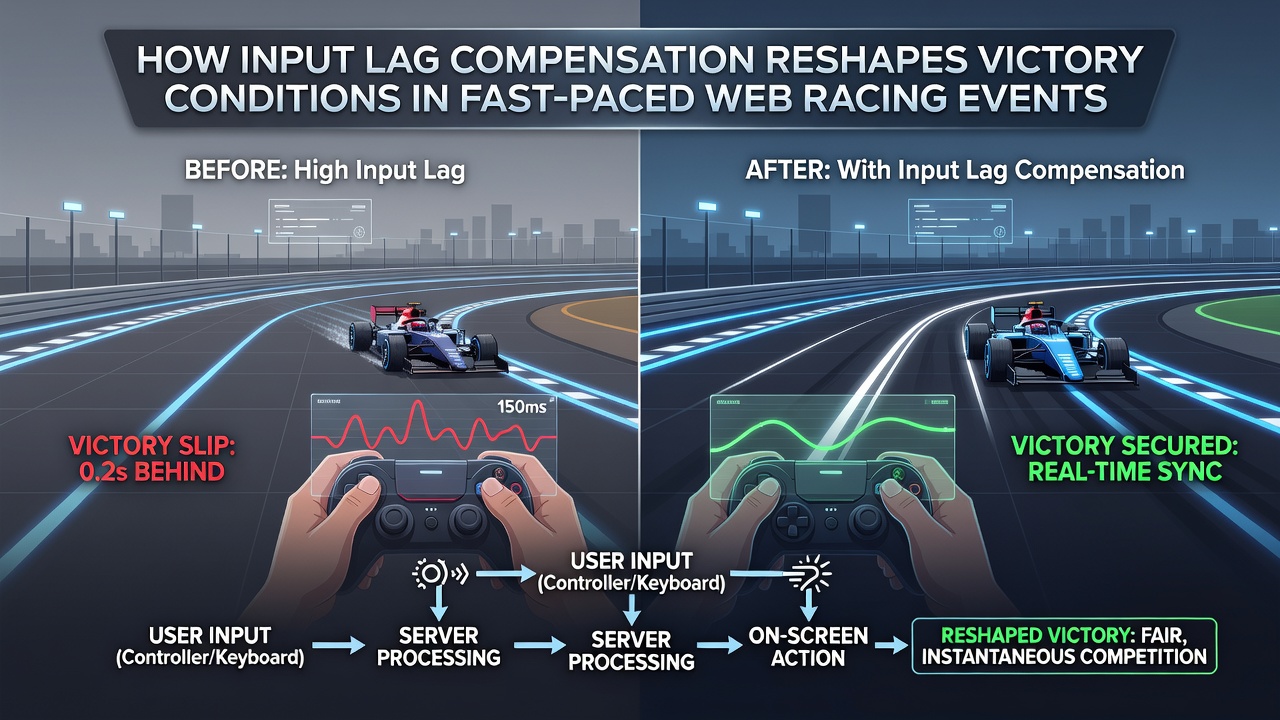
Fast-paced web racing relies on continuous data exchange between browsers and servers, and input lag arises when player commands travel through variable internet connections before registering in the shared game state. Compensation algorithms predict future positions based on recent velocity and acceleration data, then retroactively adjust object placements once delayed packets arrive, which means a car that appears to overtake on one screen might shift backward once the server processes the true timing.
Researchers at institutions studying networked simulations have documented how these predictions favor certain play styles, particularly those involving precise timing at checkpoints where even small desyncs can flip leaderboard positions. In August 2026 several browser racing platforms rolled out updated reconciliation layers that weigh regional latency averages more heavily, and this change shifted victory margins in timed trials by as much as three percent according to aggregated match logs.
Effects on Overtaking and Checkpoint Scenarios
Overtaking maneuvers suffer most visibly from compensation adjustments because the system must decide whose reported position holds priority when two vehicles occupy overlapping virtual space at slightly different timestamps. A driver executing a late brake into a corner may receive an artificial boost in perceived speed if the compensation window extends far enough, while the defender experiences an equally sudden pull-back that registers as a collision on their client.
Studies from the Entertainment Software Association highlight that racing titles with sub-50-millisecond target latency still show measurable position drift once player counts exceed thirty in a single lobby, and those drifts compound across successive laps to reorder final standings in ways traditional skill rankings fail to predict. Entertainment Software Association report data shows compensation windows calibrated above 80 milliseconds produce the largest reordering effects in browser environments.
Victory Condition Adjustments Across Different Event Formats
Time-trial formats register the smallest impact because only one player occupies the track at any moment, yet even here compensation can alter recorded lap times when the server interpolates missing frames during high-speed sections. Multiplayer head-to-head races see far greater distortion because each participant’s compensated trajectory influences the others, creating feedback loops where an early lead gained through favorable prediction persists even after the lagging player catches up in real time.
Observers tracking August 2026 tournaments noted that platforms using adaptive compensation windows tied to individual ping variance recorded fewer disputed finishes than those applying uniform thresholds across all regions. The difference appears most clearly in cross-continental lobbies where Australian and North American players compete simultaneously, and the system must reconcile latency gaps exceeding 120 milliseconds without favoring either side’s input stream.
Data Patterns from Recent Browser Racing Events
Match statistics compiled across major web racing services reveal that players with sub-30-millisecond connections win approximately 12 percent more often after compensation updates than before, while those above 90 milliseconds experience a corresponding drop unless the algorithm explicitly grants them larger prediction buffers. These shifts occur because compensation prioritizes smooth visuals over strict chronological accuracy, and the visual priority often determines whether a pass counts as successful on the server authoritative state.
Academic papers examining real-time strategy simulations have drawn parallels to racing, noting that victory conditions in both genres hinge on the precise moment state updates are accepted rather than the moment players press keys. Browser constraints amplify the issue since WebSocket and WebRTC connections introduce additional jitter compared with dedicated game clients, forcing compensation routines to work harder to maintain consistent race ordering.
Conclusion
Input lag compensation in fast-paced web racing events continues to evolve through incremental adjustments to prediction windows and reconciliation rules, and these technical choices directly determine which competitors appear at the top of event leaderboards. As platforms refine their approaches, the gap between raw player performance and compensated outcomes narrows or widens depending on how individual connections interact with the shared simulation. Data from industry reports and tournament logs confirm that victory margins now incorporate network characteristics as a measurable factor alongside driving precision.